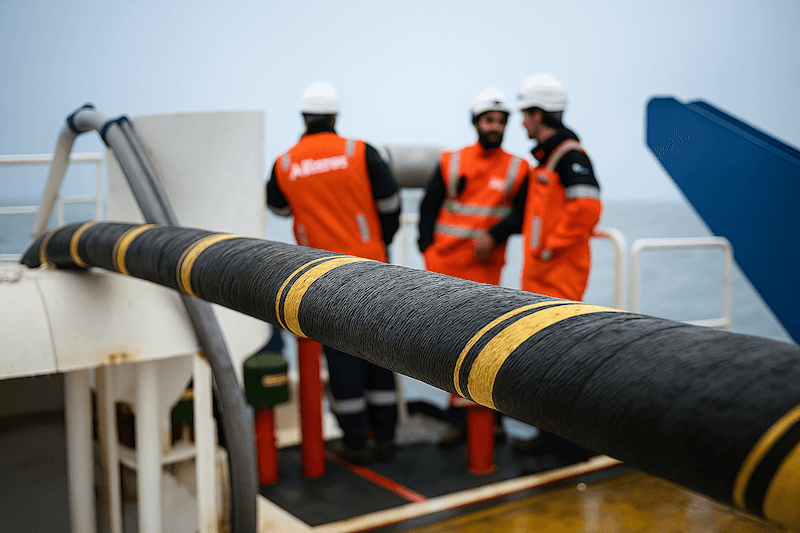
Submarine communications cable aboard a cable-laying ship

How it works

The internet is physical. So is the speed.

When you open YouTube in Shanghai, your data does not float through the air. It travels down an actual fiber-optic cable on the ocean floor to a server in another country. China has only a handful of those cables, all run by state-owned carriers. Think of them as the highways out of the country. The reason most VPNs are slow has almost nothing to do with their app, and almost everything to do with which lane of that highway they drive on.

Two roads out of China.

Same destination. The lane is what decides whether a 9 p.m. video call survives.

Standard routeevery other VPN, shared public transit
jammed at 9 p.m.
ThroughwireCN2 GIA premium, private dedicated route
clear at 9 p.m.

Shared lane: 6 to 30% packet loss at peak. Fine for a quick search, breaks under a real workday.

Premium lane: under 1% packet loss, 100 to 500 Mbps, the same in the evening as at noon.

  1. 1

    Every ordinary VPN shares the cheapest lane.

    The cables out of China have different lanes. Almost all consumer traffic, including ExpressVPN, NordVPN, Surfshark and the rest, rides the cheapest, most crowded one. It is fine at 3 a.m. By evening, when hundreds of millions of people are online, that lane becomes a traffic jam. Video calls freeze. Uploads stall near the end. The app is not broken. The road under it is.

  2. 2

    The firewall watches that crowded lane.

    Because millions of people funnel through the same public lane with the same recognizable VPN patterns, it is also the easiest place to inspect. China’s filtering looks for those patterns there and resets the connections it spots. A VPN can be excellent software and still lose, because it is standing in the most watched line.

  3. 3

    We run a different lane, and we do not look like a VPN.

    Throughwire sends your traffic down China Telecom’s premium route, the one banks and multinationals use for business-critical work. It is not crowded and it is not flagged, because the traffic on it looks like ordinary company activity. On top of that, our connection is shaped to look like a normal encrypted website. To the firewall there is simply nothing unusual to catch.

The two pieces that make it work.

You do not need to memorize these. You just need to know they are the good ones, and that almost nobody else bothers.

The route

CN2 GIA

The empty premium highway.

China Telecom’s top-tier international route. It is the lane reserved for banks, governments and large enterprises, and it stays fast in the evening precisely because it is expensive and almost nobody runs consumer traffic on it. We do.

The protocol

VLESS-Reality

Encryption that cannot be picked out.

A modern transport that makes your tunnel look identical to a normal HTTPS website, not a VPN. Deep packet inspection has nothing to flag. It is fast and strongly encrypted at the same time, instead of trading one for the other.

Speed is the route. Staying connected is the protocol. Most services get one at best. The combination is the whole secret, and it is why the connection holds when everything else on the shared lane is failing.

Why not just buy the premium lane yourself?

You cannot. CN2 GIA is not sold to individuals. It needs a commercial agreement with China Telecom and a registered business entity, at enterprise cost. It is infrastructure, not something you sign up for online. Throughwire carries that arrangement and shares one private, dedicated route across a small number of users, never millions. That is the real reason the speed holds up.

Same speed at 9 p.m. as at noon, because the road and the disguise are both right.